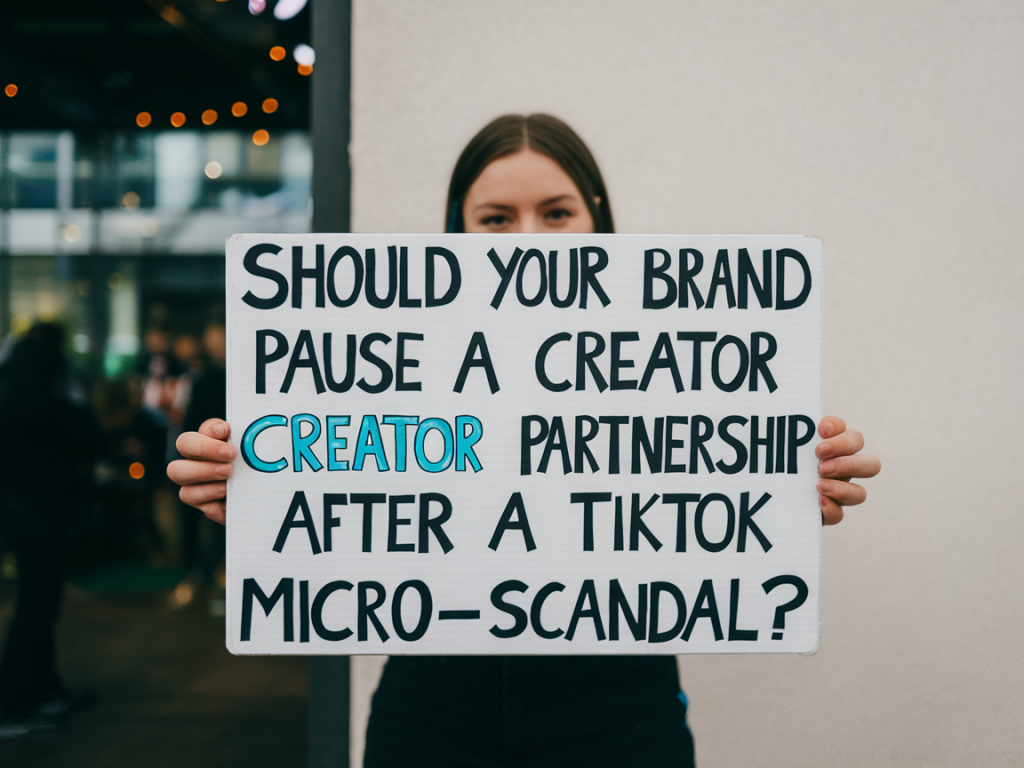
I get asked this question a lot: when a creator I'm working with gets swept up in a TikTok micro‑scandal — a resurfaced clip, an ill‑judged joke, or a viral accusation that hasn't yet become mainstream news — should the brand hit pause on the partnership? My answer is rarely a flat yes or no. It depends. But there is a clear, practical way to think about it, and that's what I want to share here.
What I mean by "micro‑scandal"
When I say micro‑scandal, I'm talking about incidents that spark measurable outrage or negative attention within the creator's community or among platform users, but haven't yet escalated into sustained mainstream media coverage or legal action. Examples include:
a creator's old joke or video resurfacing that some users find offensive;a short clip showing tone‑deaf behavior in a specific context;an allegation of poor conduct (rude behavior, missed commitments) that is shared widely on TikTok or X but not substantiated elsewhere;an influencer making a controversial statement during a livestream that provokes backlash for a few days.These situations are fast, often noisy, and may fizzle out — but they can also morph into bigger problems. Brands need to move quickly, deliberately, and in line with their values.
First principle: assess impact, not impulse
My first rule is simple: don't react to the loudest comment. React to the impact. Ask these immediate questions:
How large and engaged is the creator's audience, and how likely is the scandal to reach our customers?Is the content or allegation against the creator directly at odds with our brand values, product category, or a current campaign?Is there evidence this will attract mainstream media or regulatory attention?Is the creator's behavior a one‑off lapse, or does it indicate a pattern?Measure: look at sentiment of comments across platforms, rate of share increase, number of unique accounts discussing it, and whether any verified reporters have picked it up. If possible, use your social listening tools to quantify volume and velocity. If your risk team or PR agency flags the story as likely to escalate, treat it seriously.
Decision framework I use
Over the years I've developed a quick decision flow that balances speed and nuance. I run through four buckets:
Low risk — monitor: The incident is minor, unlikely to affect your audience, or the creator has apologized and the community is calming down. Continue the campaign but intensify monitoring.Medium risk — temporary pause + review: The creator's actions conflict with messaging or could hurt conversions, but there's additional context to gather. Pause paid amplification or upcoming posts while you investigate.High risk — suspend or terminate: The creator has engaged in hateful, violent, or criminal behavior, or the scandal directly undermines the campaign's integrity. End the partnership and prepare a public statement if necessary.Context dependent — conditional continuation: There are circumstances where you continue but with conditions: public apology, restorative actions, or content edits. This often suits creators with strong audience trust who made a clear mistake.When in doubt, I default to "pause + investigate" rather than an immediate public firing. A hasty termination can backfire (see "cancel culture" backlash) and often signals poor preparation on the brand's part.
How to pause without creating more noise
Pausing a creator partnership is not just a flip of a switch. The way you handle it shapes how the public perceives you. Here are practical steps I recommend:
Cut paid promotion, not organic activity immediately: Stop boosting or publishing paid posts scheduled to run while you gather facts. Keep a close eye on organic posts but avoid deleting unless clearly necessary and agreed with legal.Contact the creator privately: Ask for their perspective, timeline, and whether they'll issue a statement. Treat them like a partner — it often de‑escalates the situation.Inform internal stakeholders: Let PR, legal, and senior brand leads know within hours. Prepare a single agreed line for external questions.Increase listening: Track mentions by geography and audience segment. Use sentiment brackets (positive/neutral/negative) and watch for escalation signals like verified journalists picking it up.Decide on a timeline: Set a clear deadline for your review (24–72 hours). Communicate that timeline to the creator and stakeholders.What to say (and what not to say)
If the story becomes public or someone asks why the partnership was paused, here's how I advise teams to communicate:
Be transparent but measured: "We're pausing our partnership while we review recent developments." This shows action without premature judgment.Avoid definitive public accusations: Don't cast blame until you have facts. Saying "we've terminated due to X" when X isn't validated can be risky legally and reputationally.Reinforce your values: If relevant, reiterate your brand's commitments — e.g., to inclusivity, safety, or responsible behavior.Have a plan for outcomes: If you decide to reinstate the partnership, have a plan to explain why. If you terminate, be ready to explain how you reached that decision and any steps you took (investigation, consultations).Contractual levers you should have in place
A lot of stress can be avoided with the right contract clauses. If you're negotiating creator deals, include:
Morals clause: Clear definitions of behaviors that enable suspension or termination, including social conduct and platform policies.Pause language: Ability to suspend paid activations temporarily while investigating, with defined time limits and remedies.Content review rights: For sensitive categories, rights to pre‑approve content or to require edits.Indemnity and representation: Warranties from the creator about originality, disclosures, and prior conduct.It's not enough to have clauses — ensure your legal and procurement teams can execute them quickly when needed.
When re‑engaging makes sense
I've seen brands successfully re‑engage creators after a micro‑scandal when the following conditions were met:
The creator issued a sincere, specific apology and took concrete corrective steps.The scandal was proportionate to the creator's intent (e.g., a joke vs. a hateful remark), and the audience largely accepted the apology.The brand's audience data shows no sustained negative sentiment and no meaningful drop in purchase intent.The creator's future content aligns with a remediation plan — educational content, community work, or a change in behavior.When re‑engaging, I recommend a phased approach: resume organic collaboration first, then small paid tests while monitoring KPIs closely.
Real talk about optics and cost
Pausing is cheap; terminating is expensive. Pausing allows time for context while protecting your brand. But avoid the "we paused then apologised for pausing" trap — have your statements prepared and aligned with your values. Remember: consumers are more forgiving of brands that act thoughtfully than those that react theatrically.
Practical checklist you can use right now
Use this immediate checklist when a creator micro‑scandal hits:
| Action | Who | Deadline |
| Pause paid promotion | Campaign manager | Within 1 hour |
| Contact creator privately | Brand lead / agency | Within 2 hours |
| Alert PR & legal | Brand comms | Within 3 hours |
| Social listening report | Analytics team | Within 6 hours |
| Decision & message draft | Leadership + PR | 24–72 hours |
If you want, I can convert that checklist into a downloadable template for your team.
This is a fast‑moving space and the right call depends on context, scale, and your brand's tolerance for risk. I always recommend speed plus proportionality: move quickly to gather facts, avoid knee‑jerk public statements, and default to a temporary pause when stakes are unclear. That approach protects your brand while leaving room for nuance — and often that's the smartest move you can make.